
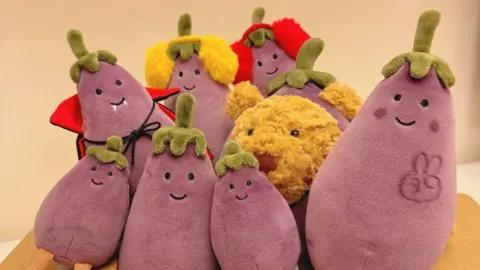
A woman named Stella acquired her initial Jellycat brand plush toy during a time of job loss during the global health crisis. Inspired by an acquaintance's passion for the UK-created creatures, her interest was fully sparked when she saw an adorable gingerbread house plushie circulating on a major Chinese social media platform.
Although Christmas isn't widely celebrated across China, being more of a retail occasion rather than a cultural tradition, the concept of gingerbread houses appealed to Stella. "The festival doesn't hold much to me... But I always like the sight of gingerbread houses," she states. This led her to request a friend in Guangzhou to buy it for her.
That acquisition took place in 2021, just as Jellycat was about to achieve enormous popularity in China and beyond. "Everyone felt jittery, and nobody knew what would happen," says Stella, who developed a habit of stroking and squeezing her plushies for comfort during that stressful time. Residing in Beijing, which experienced among the most stringent restrictions globally, she spent extended periods indoors.
Now 32 with a new job in tourism sector professional, Stella continues to grow her assortment. Her collection has grown to approximately 120 toys, representing a cost of about 36,000 yuan. "At my age, there are numerous matters that you cannot share with others... and the troubles we face are far more complex than before," she says with a sigh. "The plushies assist me in managing my feelings."
Originally marketed for children, these squishy toys have transformed into an international sensation, particularly in China where a somewhat disillusioned younger generation is seeking solace in them for comfort and solace.
The Rise of Adult Toy Enthusiasts
Her Gingerbread house toy is part of the "Amuseables" series, a range of toys featuring small expressions inspired by commonplace items, from bathroom tissue and boiled eggs. These plushies are considered the "standout products" that "attract a wide younger adult audience" globally, according to market observers.
The surge in popularity "could have a connection to a desire for companionship," suggest experts. While it's hard to ascertain if the introduction of the now-iconic Amuseable line in 2018 was a deliberate strategy to target the young adult market, companies in the sector increasingly must cultivate new markets amid falling fertility rates across numerous parts of the world.
Jellycat entered China as early as 2015. Having laid significant "foundation", the company was well-positioned to capture "the mood during Covid"—when people sought solace during heightened uncertainty—and built on this success there, according to business consultants.
Its fame was also propelled by creative temporary events. These in-store activations often featured a selection of limited-edition "food" products. Many fans record themselves interacting and post the videos online.
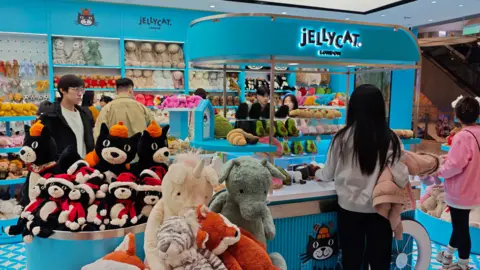
Adaptation to local tastes proved to be an essential strategy. As an example, customers were able to buy plush interpretations of traditional UK dishes such as fish and chips at a pop-up overseas. Conversely, items like teapot and teacup toys were featured at exclusive outlets in Beijing and Shanghai last year.
In 2024, the UK-based company's revenue reportedly rose significantly to reach a substantial figure. During that period, sales of roughly $117 million worth of its products in China via leading online marketplaces, per research estimates.
This growth parallels a wider surge in China's collectable-toy sector driven by young adults seeking emotional support and community. Total revenue of collectable toys nationally are expected to exceed 110 billion yuan annually, according to a 2024 analysis.
The runaway success of other toys such as Labubu, elf-like figures by domestic company Pop Mart, underscores the country's increasing appetite for collectable toys. This "kidult" trend is not exclusive to China; adults globally are increasingly re-evaluate "outdated notions of adulthood," observe academics.
Particularly, items like the aubergine plushie—nicknamed "the big boss" by Chinese fans—have inspired numerous online jokes, with many sharing grievances regarding the pressures of adulthood. The "eggplant boss" hashtag serves as a platform where people draw different expressions on their toy, showing it in different states enjoying a drink to fake-smiling.
As an illustration, one Hong Kong-based, Wendy Hui, modified her eggplant toy adding dark circles under its eyes and placing spectacles on it. She then shared a picture online captioning it: "The mood of employees on Monday." "I kept working from home even on my days off," she explains. "I merely intended to express how exhausted I felt."
Thus, the brand has emerged as an unexpected, whimsical outlet for China's youth to air their grievances over economic challenges, in which dedicated effort doesn't always guarantee comparable returns. Despite heavy online censorship, digital spaces have become an important, if not the only, space for these types of discussions.
The brand's frequent releases of exclusive designs and the discontinuation of certain lines—an approach sometimes referred to as "hunger marketing" in China—has also driven {
